Heartflow® Analysis CT - Phoenix, AZ

A Non-invasive Look Into Your Heart's Health
SMIL Southwest Medical Imaging is advancing the assessment of your heart health with Heartflow Analysis. Using images from a non-invasive heart scan, also known as a coronary CTA, this AI-enabled heart test provides a personalized 3D model of your coronary arteries that shows how disease may be impacting blood flow to your heart, as well as identifying the amount, location, and type of plaque present. This detailed information helps you and your doctor better understand the severity of your disease and determine a personalized treatment plan.6,7
Coronary Artery Disease (CAD) is the most common type of heart disease and the leading cause of heart attacks. 1,2 It occurs when plaque builds up in the coronary arteries, potentially restricting blood flow to the heart. This buildup can result in chest pain or even lead to a heart attack. Most people who suffer a heart attack don't have prior symptoms and are considered low risk by traditional measures. 3,4
A heart attack shouldn't be the first sign of heart disease. CCTA + Heartflow Analysis offers a more comprehensive 5 view of your heart's health, allowing more informed decision making for you and your physician. 6,7
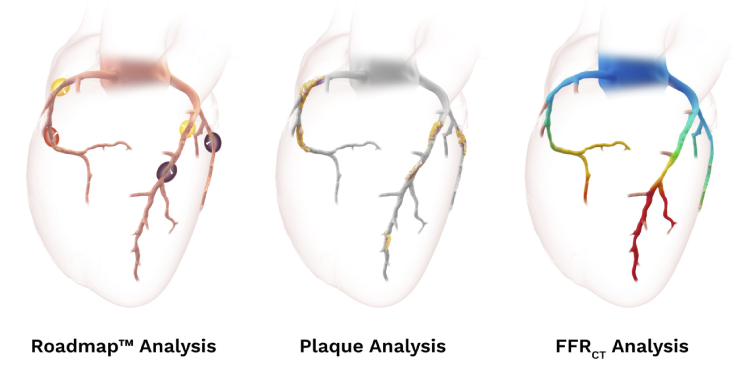
Why a CCTA + Heartflow Analysis?
- Non-Invasive: Heartflow Analysis is a technology that uses images from your heart scan, so no invasive tests or anesthesia are needed.
- Accurate: Heartflow Analysis has demonstrated superior accuracy in diagnosing CAD7,8 and is clinically proven to align with results from more invasive tests.9
- Personalized: Heartflow builds a personalized, 3D model of your arteries, using images already taken during your heart scan.
- Comprehensive: Heartflow Analysis can go beyond calcium scoring by identifying higher risk plaques that are most likely to cause a cardiac event.5
- Guides Treatment Decisions: Heartflow Analysis identifies how much and what type of plaque is present in your arteries and measures any blockages that could be limiting blood flow to your heart, providing information to help guide your personalized treatment plan.6,7
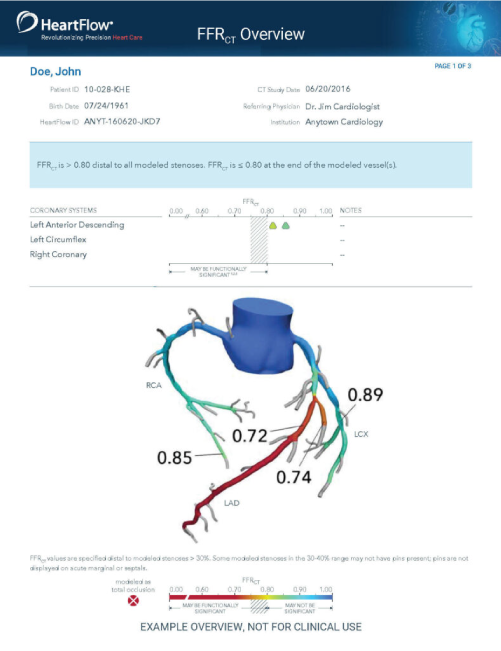
How it Works
- Scan: Your doctor will order a non-invasive Coronary CTA (CCTA) scan of your heart to look for disease.
- Measure: Using your scan, the images undergo advanced AI processing to generate a personalized, 3D model of your arteries. Your report will measure blood flow and plaque buildup in your coronary arteries.
- Act: Your doctor receives a personalized, color-coded 3D model of your coronary arteries and detailed insights about your heart. With all the information in hand, you and your provider can make an informed choice on the best treatment pathway for you.5,6
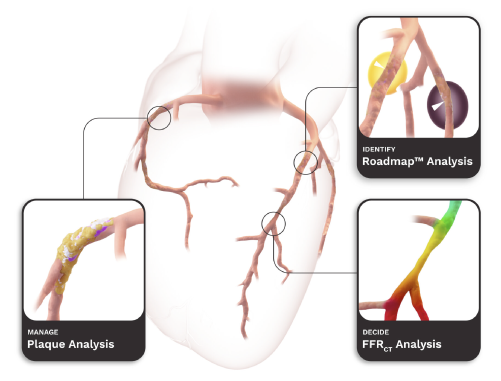
Heartflow Analysis may not be appropriate for all patients. If your provider suspects coronary artery disease and orders a Coronary CT scan, they may decide that you are eligible for a Plaque Analysis, FFRCT Analysis, or both. While no diagnostic test is perfect, FFRCT and Plaque Analyses have demonstrated better accuracy compared to other non-invasive cardiac tests. 8, 9
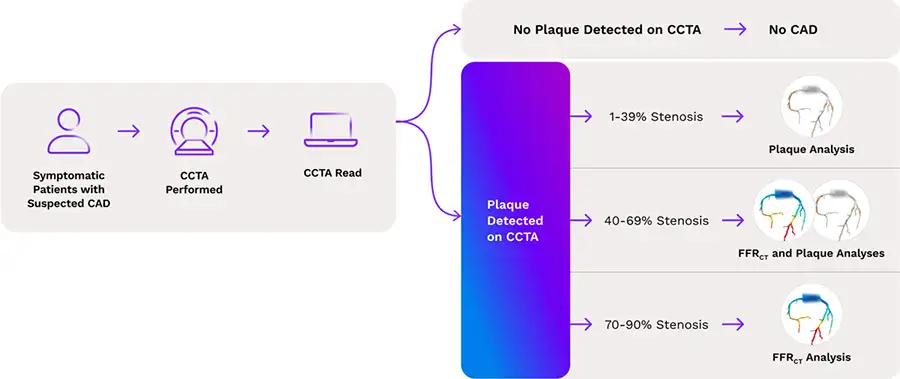
For eligible patients, Heartflow Analysis is covered by Medicare. Most commercial insurers cover the flow measurement part of the analysis, and there is some coverage by commercial insurers for the plaque measurement portion of the test. Please contact your insurance company to determine your coverage and estimated cost.
Your Step-by-Step Journey
Your doctor has ordered a Coronary CT Angiography (CCTA) and may have also requested a Heartflow Analysis (FFRCT and/or Plaque Analysis). This document walks you through what to expect, step by step.
- We Receive Your Order & Contact You
After your doctor sends us your order, you will receive an automated phone call from SMIL, usually within 48 hours, confirming receipt and connecting you with a scheduler. If you don't hear from us within 48 hours, please call our scheduling team directly at 480-425-5030. - Schedule Your Appointment
Our scheduling team will work with you to find a convenient date and time. Please have your insurance information ready. Note: This type of exam cannot currently be scheduled online. - Insurance Authorization & Preparation
Our Patient Access team will review your medical records and handle any prior authorization your insurance requires. We'll contact you if any issues come up. - Pre-Appointment Call from a Nurse
A nurse will reach out before your appointment by phone or text to review your medical history, understand the medications you are currently taking, answer questions, and go over exam preparation instructions. - Your CCTA Scan
Arrive early for check-in and paperwork. A radiologist will review your CT images after the scan and determine whether Heartflow Analysis is appropriate for you. - Heartflow Analysis (if recommended)
If you are a candidate, our team will contact you to review your cost estimate and confirm your approval before anything is done. Your existing CT images are sent to Heartflow no additional scan is needed. If you would like to speak with a SMIL team member regarding your estimate, please call 480-425-5098 or email patientestimates@esmil.com. - Results Sent to Your Doctor
A radiologist reviews the Heartflow results, which are added to your CCTA report and sent to your ordering provider. Please contact your doctor's office for your results.
Still have questions?
Our team is ready to help you every step of the way.
Scheduling: 480-425-5030 | Pricing: 480-425-5098
Citations:
- Heart Disease Facts. CDC. Accessed December 18, 2024. https://www.cdc.gov/heartdisease/data-research/facts-stats/index.html
- Heart Attack. CDC. Accessed December 18, 2024. https://www.cdc.gov/heart-disease/about/heart-attack.html
- 2010 ACCF/AHA Guideline for Assessment of Cardiovascular Risk in Asymptomatic Adults Circulation. November 2010.
- Preventing myocardial infarction in the young adult in the first place: how do the national cholesterol education panel iii guidelines perform? Journal of the American College of Cardiology. May 2003.
- Williams MC, et al. Circulation. 2020. doi: 10.1161 CIRCULATIONAHA.119.044720
- Rinehart S, et al. JSCAI. 2024. doi: 10.1016/j.jscai.2024.101296
- Douglas PS, et al. The PRECISE Randomized Clinical Trial. JAMA Cardiol. 2023;8(10):904–914. doi:10.1001/jamacardio.2023.2595
- Driessen, et al. J Am Coll Cardiol 2019; Norgaard, et al, Euro J Radiol 2015.
- Narula J, et al. Eur Heart J. 2024. doi: 10.1093/ehjci/jeae115
SMIL locations providing Heartflow services:
NORTH SCOTTSDALE
SOUTH SCOTTSDALE
PEORIA
PHOENIX
SMIL Southwest Medical Imaging Services